Pain-Free for the First Time in Years
Share this page:
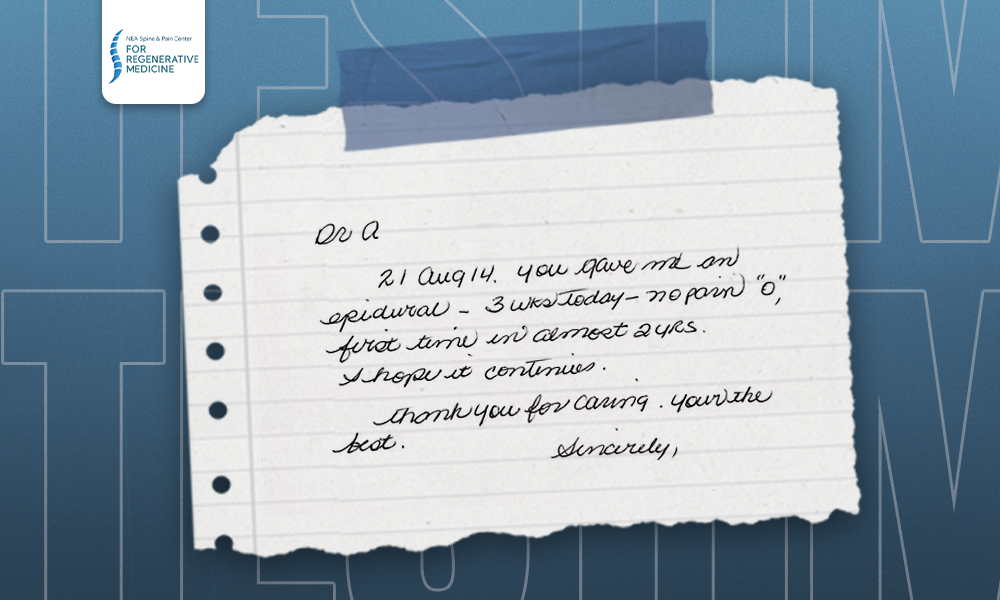
In August 2014, this patient received an epidural injection from Dr. Abraham after struggling with severe pain for years. After the treatment, he experienced something he never thought possible — zero pain for three weeks, which is the first time in years.
This wasn’t just a physical transformation; it was the restoration of his life. He is deeply grateful for Dr. Abraham’s expertise. His care has made his life better, and he truly believe Dr. Abraham is the best at what he does.
Epidural injection:
The epidural injection is injected into the epidural space, the area around the spinal cord, to temporarily or permanently reduce pain or inflammation in the extremities (arms and legs) or spine. The epidural space is the outermost part of the spinal canal. Epidural injections are steroids, anesthetics, and anti-inflammatory drugs.
To get the most advantage, Dr. Abraham inserts the needle correctly using imaging guidance, such as computed tomography (CT scan) or fluoroscopy (multiple x-ray images), to precisely target the area causing the pain. Additionally, the injection could help identify the exact location of the pain.
What are some common uses of the procedure?
An epidural injection may be administered to alleviate pain caused by a herniated or bulging disk that impinges on nerves, causing pain, spinal stenosis, post-operative "failed back" surgery syndromes, other injuries to spinal nerves, vertebrae, and surrounding tissues, and bone spurs.
What is the mechanism of the epidural injections?
Patients experience varying effects depending on the type of drug injected into the epidural area. Corticosteroids are anti-inflammatory drugs that reduce swelling and nerve irritation, allowing the nerve to heal and preventing additional pain. When an epidural injection is injected into the epidural space, the drug travels throughout the space and coats the irritated or inflamed nerve roots.
Pain in the lower back and the nerves that radiate to the lower limbs, such as the sciatic nerves, may be relieved by a lumbar (lower back) injection. Also, the cervical epidural injection should permeate the cervical epidural space and relieve the neck nerve roots, which may also alleviate arm pain.
The effect of the epidural injection varies. For some people, the relief is permanent. The effects might not be long-lasting in others. In certain situations, you could require repeated injections before experiencing noticeable relief. For a few days to several months, a patient may feel better, but eventually the pain may return, necessitating further injections or an alternative treatment.
Pain in the lower back and the nerves that radiate to the lower limbs, such as the sciatic nerves, may be relieved by a lumbar (lower back) injection. Also, the cervical epidural injection should permeate the cervical epidural space and relieve the neck nerve roots, which may also alleviate arm pain.
The effect of the epidural injection varies. For some people, the relief is permanent. The effects might not be long-lasting in others. In certain situations, you could require repeated injections before experiencing noticeable relief. For a few days to several months, a patient may feel better, but eventually the pain may return, necessitating further injections or an alternative treatment.
The benefits of epidural injections:
• It offers short-term or long-term pain management.
• It reduces the inflammation in the painful area of the spine, either temporarily or permanently.
• It enhances the ability to carry out regular tasks without the limitations brought on by pain.
• It could determine where the pain is coming from. This is frequently an issue for people whose pain may have multiple causes.
• It could lessen the need for invasive interventions.
If you are suffering from chronic pain, don’t wait. Experience the same relief and care under Dr. Abraham’s expertise. Start your journey to recovery today.